
Reaching in stronger breezes
Home Page
Index for sailing
Tactics and Rules
The Boat
|
The boat can be pushed hard
on a reach in fresh winds (see sequence further below) but as
the breeze pipes up, shifting the helm's weight backwards fast may be
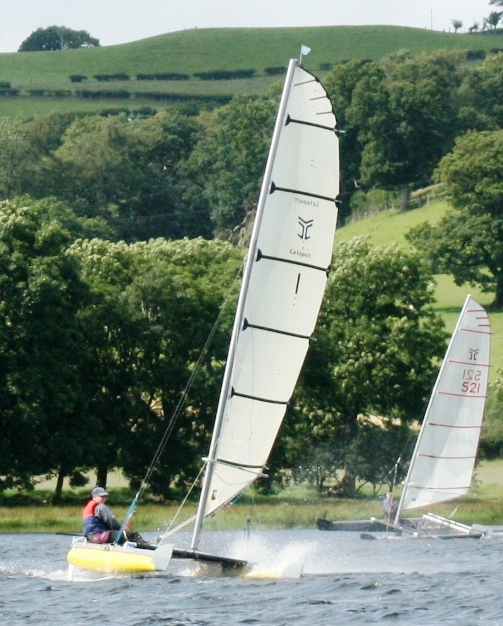
needed to keep the bows up in gusts Stuart, right is watching the bows dip as he bears away onto the reach at the windward mark at Grafham. The bows go down with the wind pressure on the boat (which has been slowed by the turn) but they will lift as Stuart slackens the main off more and the speed picks up. He shows no sign of shifting his weight further aft---so the overall "feel" must be that the boat is safe and he can predict it will lift. In a stronger breeze still, he would shift aft as he came to the mark, and slacken off quickly. (Rounding the windward mark like this is when the Extreme 40's go in) The sequence below demostrates driving the boat on a reach in a brisk breeze, at the 25th Anniversary regatta at Bala, as Alex pushes Catapult 1 past the spectator spit. (Photos are a few seconds apart.) |
 |
 |
 |
 |
.

(Sequence above, from
left.)
Alex reaches away from the mark,
spray flying from the lee bowboard
A gust (centre)
puts both bows down. He leans back, but does not slacken the main, and feels it is not a crisis.
(Above right)
Seconds on, through the puff, the bows are up. More seconds on
(left)
the breeze is up again, with both bows slicing into the water,
but Alex drives the boat hard, with time to check the sail setting.
(Right)
Seconds later again, Gareth reaches past the same spot.
Although the boat is not dipping at the moment, he is sitting
further back than Alex, needing (with his lighter weight) to sit
aft to counteract a gust.
Gareth comments that with the breeze strong and
plenty of pressure in the sail, attention goes from the
telltales to
watching the lee bowboard.

Until the "feel" of the boat's
safety on a reach is familiar ( a combination of judging the speed against the
wind strength, any sensation of the boat hesitating and checking as bows
drive into the water, with good balance ready to move weight aft) a
surprise can happen reaching in quite light winds.
Alex comments from the pairs race
at Bala, with
Steve "enjoying a leisurely reach in around 10 mph
of wind.
He was
fairly well forward, keeping the boat nicely balanced and
trimmed....until a gust caught
him.
The bows dug in
unexpectedly
and before he knew it, he was tumbling forward, and then the boat was on its
side.
He could have saved
the situation by quickly moving aft and also easing the mainsheet.
The bow would then have (hopefully) popped up and then the sail
could be retrimmed and rapid forward progress resumed.
My advice when reaching is Be prepared to move aft quickly, if a
gust comes If you are not powered up, to keep the boat balanced may mean moving inboard and forward Be ready to ease the mainsheet and
reduce power. If the bow goes down, it is best to ease, let things
re-settle and then engage power.
 |
DIVE!--
DIVE!---DIVE! Three helms need urgent action (Left) There is obvious alarm, but the lee bow is probably burying after bearing away quickly before slackening the main---unless he is thrown forward by the boat's sudden slowing, the helm dumping the main should do it. (Right) Chris at Bass (with much more wind than it looks) has a bigger problem---he is on a broad reach, so the main is well out already and the gust is digging the boat in, with a great tumult of white water all around. It is about to nosedive, and probably hanging over the back is the only option. |
 |
.jpg) |
(Left)
George Evans running at Bala: the whole boat has dug down into
the water, so the forces on it are very great---there is the
choice of leaning way back and hoping the gust dies, or rounding
up violently, hanging over the back, so the boat can lift again,
and be turned carefully back on course. (Outcomes: two survived, but Chris, above right, went in.) In stronger winds, keeping speed up through the gybe (turning in a wide arc and gybing when running dead downwind, with the wind pressure at its least) allows an easy gybe when all the Lasers are going over. Catapult slows in any rapid turn, so wind pressure may dip the bows while weight and position are being shifted during the gybe. Although it may seem illogical, reaching in brisk breezes on the sea has the advantage that dipping into each wave gives feedback on how close the boat is to being overpowered (although at greater strengths, the waves will "trip" the bows at a point where inland conditions could be easily managed.) Reaching at sea in a moderate breeze, with a chop running, the boat can have green water coming over the lee bow board with no feeling of an impending dive. |

back to top
Home Page
Index
for sailing
Sailing Programme
Results and Reports